
29 Sep 2026 · Written from the trip we run
The mistake almost every first-timer makes with Australia is treating it like a single destination and booking ten nights in Sydney. Sydney deserves three nights, not ten. The reef is a three-hour flight north. The Great Ocean Road is four hours south of the reef. The country is a continent, and the only way to see it properly is to move.
So this trip moves. Three nights in Sydney for the harbour and the mountains, three in Cairns for the reef and the rainforest, four in Melbourne for the coast road and the penguins. Internal flights are short and cheap; the driving is done for you. Australia is not a budget destination — a flat white costs ₹400 and a hotel room costs what it says on the label — but what you get is a trip that delivers something completely different every single day, in one of the safest, most organized countries on earth. September to March is the window: warm, dry in the south, and the reef at its clearest.
Day 1
Land, shower, ferry to Manly
Sydney airport is twelve kilometres from the CBD. You are at the hotel by midday and out the door within the hour. Walk Circular Quay, stand in front of the Opera House forecourt — not inside it, not yet — then buy an Opal card and take the public ferry to Manly. The return crossing takes thirty minutes each way and gives you the full harbour panorama, the bridge, the sails, the heads, all for the price of a bus ticket. It is the cheapest great harbour cruise in the world. Dinner tonight in The Rocks, Sydney's oldest street, where the sandstone buildings are the backdrop and the menu will have barramundi. Sleep early.
Day 2
Opera House inside, harbour at night
The Opera House guided tour runs most mornings and takes you through the concert halls, the backstage corridors and up to the views the audience never sees — book it the night before because it sells out. The afternoon belongs to Bondi: the clifftop walk south to Bronte is four kilometres of coastal scrub, sea stacks and bathers, and the Bondi Icebergs pool at the southern end is the most photographed swimming pool in Australia (you do not have to swim in it). The day ends with a dinner cruise under the Harbour Bridge as the city lights come on, the Opera House sails lit white behind you. This is the evening worth spending on.
 Blue Mountains Private Tour From Sydney, & Featherdale Aussie Animal Park Option★ 4.7 (171)from ₹27,720 per person · book on Viator ↗
Day 3
The Blue Mountains
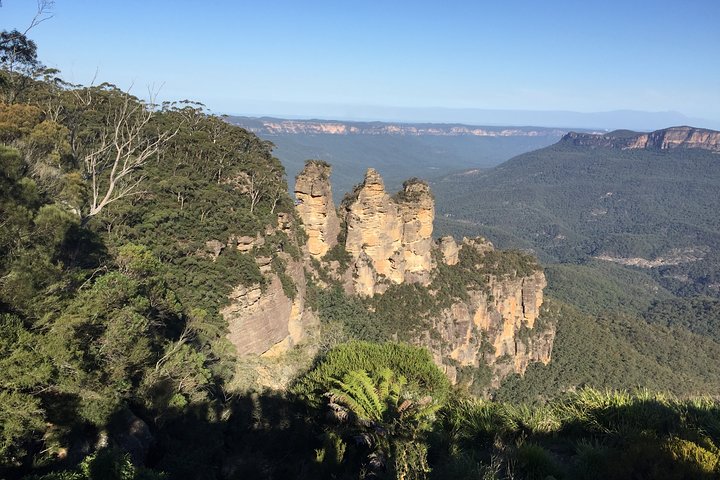
The driver heads west on the Great Western Highway — ninety minutes to Echo Point at Katoomba, where the Three Sisters sandstone formation stands above the Jamison Valley. The Scenic World railway drops near-vertically into the rainforest below; the cableway brings you back up with the valley spread out beneath your feet. Most tours stop here. The better ones pause at a wildlife park on the return journey, which is the moment to see a kangaroo that is not behind a fence and a koala that is asleep in an actual tree. Skip the souvenir shops in Leura and spend that time at the viewpoints instead. The mountains are their own souvenir.
 Blue Mountains Sunset Tour with Kangaroo Sightings from Sydney★ 4.5 (299)from ₹8,800 per person · book on Viator ↗
Day 4
Fly north; Cairns by afternoon
The IndiGo-code-share or Qantas domestic leg is three hours. The air changes the moment the aircraft doors open at Cairns — warm, thick, tropical. The afternoon is deliberately light: the Esplanade Lagoon is a free, stinger-safe saltwater pool right on the waterfront where the whole town swims, and it is the correct place to spend the first tropical afternoon. The night markets run along the Esplanade from 17:00; dinner here, the mud crab if you eat seafood, the laksa if you do not. An early night before the reef.
Day 5
The outer Great Barrier Reef
The fast catamaran leaves the Cairns marina early and reaches the outer reef pontoon in ninety minutes. Out here the coral is healthiest — the inner reef gets the run-off; the outer does not. Snorkelling gear is included and needs no experience; the water is warm, clear to fifteen metres, and the fish are indifferent to you in the best way. A guided snorkel safari and a semi-submersible glass-bottom ride are both included. An introductory dive can be added on board with no licence needed; the crew certifies you for one dive only, which is the right amount. Lunch is served on the pontoon. You are back at the marina by five, the reef still visible when you close your eyes.
 Nature & Wildlife: Australia's Hidden Side, Private Tour★ 5.0 (372)from ₹33,830 per person · book on Viator ↗
Day 6
Kuranda: rail up, Skyrail down
The Kuranda Scenic Railway leaves Cairns Central at 08:30 and climbs ninety-three kilometres of track that took five years and 1,500 workers to cut through the rainforest in the 1880s. The train passes through fifteen hand-cut tunnels and stops at Barron Falls — a thundering waterfall best seen after rain — before arriving in Kuranda village, where the markets and the butterfly sanctuary fill two hours comfortably. The return is by Skyrail, a gondola cableway that glides just above the rainforest canopy for 7.5 kilometres, with two mid-station stops where you walk boardwalks into the forest itself. This is Queensland engineering from two different centuries, and both impress.
Day 7
Fly south to Melbourne
Three hours south and the climate shifts from tropical to temperate — you will want a jacket by evening. Check in, then the afternoon is a walk through what Melbourne does better than anywhere: Hosier Lane for the street art (it repaints itself weekly), the Degraves Street espresso strip where the coffee queue tells you the standard, the Royal Arcade and Block Arcade for the Victorian ironwork, and Federation Square for the view down Flinders Street. Dinner: Chinatown on Little Bourke Street or Lygon Street in Carlton — the Italian quarter that opened in the 1950s and has never closed. Both are correct answers.
Day 8
The Great Ocean Road
The road starts at Torquay, where the surf shops tell you the coast has arrived, and runs 243 kilometres west. The driver keeps you on the ocean side. Kennett River is the koala stop — wild koalas in the grey gum trees above the road, watching you back — and Apollo Bay is lunch. The Twelve Apostles are best in the late afternoon when the limestone stacks turn gold and the crowds are slightly thinner than midday. Loch Ard Gorge is ten minutes west of the Apostles and tells the story of the 1878 shipwreck; it is short, dramatic and almost everyone skips it. Do not skip it.
Day 9
Phillip Island and the penguin parade
A slow morning, then out mid-afternoon. Phillip Island is ninety minutes from Melbourne on the South Gippsland Highway. The Nobbies boardwalk runs over a fur seal colony — hundreds of seals on the rocks, audible before visible. Wallabies appear in the scrub near the car park at dusk if you look. The main event starts precisely at sunset: little penguins — the world's smallest, thirty-three centimetres tall — come in from the sea and waddle up the beach in groups to their burrows, as they have done every evening without fail. No photography is allowed anywhere near the parade. You simply watch, in the dark, as they march past. It is one of those things that should be clichéd and somehow is not.
 Phillip Island Penguin Parade and Koalas Tour from Melbourne★ 4.8 (927)from ₹10,080 per person · book on Viator ↗
Day 10
Melbourne, your day
A free day, deliberately. We brief you on options the night before: the Queen Victoria Market for last shopping (open until 15:00 on weekdays), the MCG guided tour for the cricket-mad — you walk the outfield and see the dressing rooms — the free City Circle tram that loops the CBD, or a slow brunch and a bookshop in Fitzroy. Ten nights in, the correct Australian luxury is an unscheduled morning. Pick one thing and do it without a plan.
 MCG Tour & Australian Sports Museum★ 4.7 (313)from ₹2,800 per person · book on Viator ↗
Day 11
Home from Melbourne
Transfer to Tullamarine — allow ninety minutes from the CBD in the morning. Australia's biosecurity is strict inbound but your bag going home is the customs officer's problem, not yours. The correct final purchase is macadamia nuts from duty-free: they travel, they do not crush, and nothing says Australia more accurately. You land in India having seen a harbour, a reef, a rainforest and an ocean road that genuinely belong to four different worlds.
What this trip costs: as we run it, with five-star hotels in all three cities, every internal flight, all private transfers, the reef day, the Kuranda railway-and-Skyrail loop and the Phillip Island penguin evening, from about ₹2,73,690 a person for two travelling together, international flights extra. The Australian dollar fluctuates; prices on the ground are in AUD and quoted here as a guide. Book the pieces yourself from the experiences below and you will get close to the same number with considerably more logistics to manage — which is fine if you enjoy that part.
Best months: September to March, when Sydney is warm, the Twelve Apostles coast is clear and the reef water is settled. Avoid January on the Gold Coast and Darwin if you are extending — the wet season brings stingers, flooding roads and humidity that defeats the point. The one thing to book first is the reef day; it sells out two weeks ahead in October and November, which is peak season in Cairns. Everything else follows.
Best time to visit
What it costs beyond the package
Indicative daily spend per person, on the ground.
Shoestring
₹5,500
per day
Comfort
₹12,000
per day
Luxury
₹32,000
per day
Visa
₹11,500 · 25 days to process · Multiple entry
The Visitor visa (subclass 600) is applied for entirely online through ImmiAccount — there is no sticker in the passport and no embassy visit for most applicants, though biometrics at a VFS centre can be requested. Processing is genuinely variable: many applications clear in two to three weeks, some take six or more in the Indian holiday rush, so apply at least six weeks before travel. The grant is usually multiple entry over one year with 90 days per stay. The fee shown includes our service charge and is indicative — the AUD government fee moves with the exchange rate.
Questions people ask
- Is ten nights too long with children?
- It is built for them. No city gets less than three nights, so there is no daily repacking; the reef pontoon has a children’s pool and shaded decks; and the ninth and tenth days are deliberately slow. The one long day is the Great Ocean Road — children who nap in cars do fine, and the koalas at Kennett River are the best wake-up call there is.
- Do we need to know swimming for the reef day?
- No. The pontoon has a sheltered snorkelling enclosure, flotation vests and lifeguards, and the semi-submersible and underwater observatory show you the coral without getting wet at all. Confident swimmers get more, but nobody on the boat gets nothing.
- September to March — but is there a best slot inside that?
- For this itinerary, September to early December. The reef water is at its clearest before the northern wet season builds after Christmas, the southern cities are in spring, and fares are gentler than the December–January school-holiday peak. February and March remain excellent in Sydney and Melbourne, with occasional tropical downpours in Cairns.
- Why Cairns and not Uluru?
- On a first trip the reef wins: it fills three days richly, pairs with a rainforest, and needs no extra flying inside the loop. Uluru deserves two dedicated nights and its own flights, which would either stretch this trip to two weeks or shortchange the rock. If Uluru is your dream, tell us and we will build the trip around it instead.